affmark.in <body><a href="http://ww2.affmark.in?epl=_xME3Vgk_Ejr1IL1F7LwemjrJCxBQuEUyV38GDhbCgpyVAUkLfmddY7pdFSy9pNj_MzAwSYY1nenvXu6KQFJAZZ30WAkYMrwVnjU9BHapU0Jlq8rNIB60gzSk7RNEcpTD0BDNHnqkZ4idAAgAN6rvwAA4H8BAABAgNsHAADaOglLWVMmWUExNmhaQmUAAADw">Click here to go to affmark.in</a>.</body>

A Dame’s Rocket Meditation

June 30, 2012

“Very truly I tell you, unless a kernel of wheat falls to the ground and dies, it remains only a single seed. But if it dies, it produces many seeds. Anyone who loves their life will lose it, while anyone who hates their life in this world will keep it for eternal life.” John 12: 24-25.

As my friend Cheryl and I meditate on this scripture, a picture pops into my head: the garden, here at Cloudland, our very first spring on the property. It is a fairyland, this garden. Dame’s Rocket runs rampant, a riot of varying shades of lavender, lilac, blushing-bride pink. It’s everywhere, this tall, cone-shaped wildflower often mistaken for phlox. An intoxicating perfume wafts through the air as the flowers wave in the breeze.

“We’ve got to pull some of this stuff out,” the yard guy says. He’s been caring for this garden for years, and we’re hoping he’ll stick around to help us out, neophyte gardeners that we are.

“No,” I answer firmly. “I love it. The more of it, the better.”

“But, it’s taking over,” he answers, pulling a bandana out of his pocket to wipe his forehead.

“Good!” I answer. “I want it to take over.”

Little did I know, at that point, that Dame’s Rocket proliferates by seed. And all those beautiful flowers, waving their pretty purple heads in the breeze, are loaded with seeds. Even when pruned, Dame’s Rocket comes back.

Our first winter here at Cloudland, the garden snoozed, brown and gray; not much to look at. Then came spring, and Dame’s Rocket was everywhere, and I mean, everywhere. You couldn’t see the hosta or day lilies or columbine, or anything else, for that matter. As the yard guy predicted, the Dame’s Rocket had taken over.

By that point, the yard guy was gone, having followed the woman whose house we’d bought to her new place in town. He probably didn’t want to work with a wanna-be gardener like me who didn’t do her homework.

“Very truly I tell you, unless a kernel of wheat falls to the ground and dies, it remains only a single seed. But if it dies, it produces many seeds.”

Come early summer, the Dame’s Rocket died. It produced many seeds. Its seeds fell to the ground, they germinated over the winter, and in the spring, they produced many flowers. Hundreds of flowers. Thousands of flowers. Now I know it’s okay to prune them back once they’ve died. The garden not only looks better rid of those bare, leggy, straggly stems; every time I pull one up and shake it, seeds scatter, ensuring a yield of a hundred-fold in the coming year.

What if I allow myself to die? What if I quit holding on so tight to some of these things that I can’t bear to let go? My sons’ happiness. My mother’s happiness. My husband’s happiness. My plans for Joel’s future. My plans for Cloudland. My plans for me.

Hmmm. I see a pattern here. Everyone else’s happiness, and my plans…my plans…my plans.

What happens if I let these things go, let them die, let these seeds be buried in the ground that is me. What if I let the Lord prune me? If I quit squirming or just plain running away when He gets out those pruning shears? What will grow up in the seasons to come?

My garden tells me…the Scriptures tell me…I will become a garden running rampant with flowers that wave in the breeze of the Holy Spirit, producing the sweet aroma of Christ to God.

I sit on the porch this morning, June almost gone, the corn bowing down in the wild wind that flew in with the dawn. Corn, planted as seed in May, miraculously filling the fields today, growing toward the fulfillment of harvest.

“Very truly I tell you, unless a kernel of wheat falls to the ground and dies, it remains only a single seed. But if it dies, it produces many seeds. Anyone who loves their life will lose it, while anyone who hates their life in this world will keep it for eternal life.”

Lord, I give it all up to you. Tend these precious seeds, Father/Mother/Yard Guy God. I will wait, in anticipation, just as I wait for my fairyland of a garden each spring.

A Meditation on Psalm 42

June 19, 2012

As a hart longs for flowing streams, so longs my soul for thee, O God. My soul thirsts for God, the living God. When shall I come and behold the face of God? My tears have been my food day and night, while men say to me continually, “Where is your God?”

I carry Bible and journal out to the yard, needing to release steam from the pressure cooker of my emotions. It’s a picture-perfect June day. The corn rustles in the breeze; the dry grass, when walked on, smells like summer itself. The squirrels play ring-around-the-rosy in the maple, and the dappled shadows of leaves blowing in the wind create an ever-changing pattern on the grass in front of my chair. A bright blue jewel of an indigo bunting flashes in front of my eyes. Beauty at its best, and yet, I cannot take it in.

My son is unraveling, day by day, week by week. I can’t cry anymore. Warm tears have frozen, an icy dagger plunged deep in my heart. It scares me, this anger, and so I bury it deep inside. Problem is, this wrapped-up, tucked-away anger doesn’t disappear. It decays like fish wrapped in newspaper, poisoning body and mind. I withdraw from the people I love. Prayer is a desert without water or words. Meditation impossible.

These things I remember, as I pour out my soul: how I went with the throng, and led them in procession to the house of God, with glad shouts and songs of thanksgiving, a multitude keeping festival. Why are you cast down, O my soul, and why are you disquieted with me? Hope in God; for I shall again praise him, my help and my God.

I remember, Lord. I remember praising you in Jerusalem, just weeks ago. I remember calling your name from the wall surrounding the city. I remember standing on the ramparts and commanding the Enemy, in the name of Jesus to go, to depart. I remember standing at the western wall of the temple, hands on warm stone, pouring out my heart. I remember glad shouts and songs of thanksgiving from the Jerusalem Prayer Tower, a multitude of eight, keeping festival.

Help me. Lord. I want to praise you again. I know, from reading your Word, that you knew anger. Fully God, yet fully man, there is no human emotion you did not know. You over-turned the money-changers’ tables in the temple. I stood there and envisioned it. You chastised the Pharisees, calling them white-washed tombs. I encountered them, lost on their streets and subject to their man-made righteousness. You didn’t stuff your anger. You told it like it was. You were honest. You demanded justice.

Why am I so afraid of these feelings? They concern my son, after all. My autistic son, the one who can’t speak for himself. The one who so often communicates to us through behavior rather than words. His behavior these last few months tell us that something in his life is intolerable. And so he lashes out at the closest person. Pulling hair. Pulling glasses off of faces. Hitting. Throwing rocks.

I spend my days trying to put together the puzzle of what he’s struggling to communicate. The wrong medication? Too much of the right medication? Is it pain? Do his wisdom teeth need to come out? Is he experiencing back pain from his kyphosis? Do his feet hurt? Or is it his sensory system, overloaded with too many choices, too much space? Or perhaps his sensory system is under-stimulated? Is he bored? Unhappy? Homesick? I make appointments with the appropriate doctors and therapists, as we carefully fit the puzzle pieces together, one-by-one. My anger seethes at myself, for not being able to solve the puzzle; at his father, for not working harder to help me solve the puzzle; at the management of the farm where he lives, who have not, from the beginning of working with him, listened to what I’ve said he needs; who have not given him the structure he needs to be successful.

My soul is cast down within me, therefore I remember thee from the land of Jordon and of Hermon, from Mount Mizar. Deep calls to deep at the thunder of thy cataracts; all thy waves and thy billows have gone over me. By day the Lord commands his steadfast love; and at night his song is with me, a prayer to the God of my life.

I’ve been so tempted lately to give the whole thing up, this placement for my son that we believed was of God. And yet, I remember meeting you by the Sea of Galilee just weeks ago, the place you promised to meet me. I stood by the shore and looked, and there you were, in the symbol of two white birds, flying side by side along the seashore, then heading out to sea. You and me, Lord. You and me. You teach me how to fly. You keep me safe while at the same challenging me to take risks. Moving Joel out of the home was a risk. Keeping up the good fight to make it work for him at the farm, is a risk. Going to Israel was a risk. Yet through the turbulent waters, you are with me. You are with Joel. Your love for us is steadfast. You will never leave us.

I say to God, my rock: “Why hast thou forgotten me? Why go I mourning because of the oppression of the enemy?” As with a deadly wound in my body, my adversaries taunt me, while they say to me continually, “Where is your God?”

O Lord, I have felt forgotten lately. I seek your face and do not find you. My adversaries are not of flesh and blood, but are “the principalities, the powers,” the “world rulers of this present darkness,” the “spiritual hosts of wickedness in the heavenly places.”

I see today that the poison eating away at my heart is of my own doing. I have given in to the Enemy’s ways of unforgiveness and resentment. You told me in prayer just a few days ago, Lord, that the life-preserver I am to put on in this spinning boat of my life is praise. I know that you sit at table with us as we put together this puzzle of Joel’s life with autism. All I have to do is look back and remember to realize you have never abandoned us. I will not succumb to poison arrows or despair. I forgive myself, Wally, those in charge of Joel’s care. I give it all up to you, Lord. I know you give wisdom, insight and courage to those who ask. Help me to take the actions I need to take to help my son flourish and prosper and grow.

I praise you, Lord. You are my help. You are my God.

Why are you cast down, O my soul, and why are you disquieted within me? Hope in God, for I shall again praise him, my help and my God.

The Glory of God

May 22, 2012

The heavens are telling the glory of God, and the firmament proclaims his handiwork. Day to day pours forth speech and night to night declares knowledge Psalm 19:1-2

I’m sitting on the deck, meditating, when a wren’s raucous song jolts me back to earth. Open your eyes, she cries. Open your eyes!

I open my eyes to find the world ablaze with the glory of God – shining from shook foil – as the leaves of the walnut shimmer in the breeze, refracting green waves of light across the lawn. A pair of robins play tag through the trees, jousting for position in mid-air before disappearing into the woods. Impatiens glow, fuchsia jewels in morning sun, and the sweet potato vine cascades, a humble yet magnificent lime green waterfall. A hummingbird, buzzing like a bee, hovers in front of me, chirps good morning, then sips nectar from a host of clown flowers.

Open your eyes, cries the wren. See the rainbow in the spider’s web stretching from deck rail to chair, watch the speckled caladium bow and dance in the wind, clap your hands for the fly-catcher practicing acrobatics in the summer blue sky. Open your eyes to the glory of God!

A Fairy Tale Come True

May 7, 2012

After Wally leaves for work, I bring my Bible, journal, and tea into the garden. A light mist hovers over the fields across the road, and I am surprised to see tender green shoots of corn forming rows where yesterday there was nothing but dirt. All around me, Dame’s Rocket thrusts purple and white spires toward the skies like holy hands reaching toward heaven. Boxwood shimmers greenly in the breeze, and a yellow weed at the fence line bursts into flame as a sunbeam peeks through the clouds.

The words of Psalm 63, my reading this morning, reverberate through my mind. “O God, thou art my God, I seek thee, my soul thirsts for thee; my flesh faints for thee, as in a dry and weary land where no water is. So I have looked upon thee in the sanctuary, beholding thy power, and glory. Because thy steadfast love is better than life, my lips will praise thee. So I will bless thee as long as I live; I will lift up my hands and call on thy name.”

In the sanctuary of this garden the desert landscape of my heart enters an oasis of green, flowing with streams of living water. As I drink from the cup held out to me, praise wells over. With the praise, yesterday’s testimony, given by a woman at the Oxford Vineyard, floods my heart, mind, and soul.

Jessica, a high school student, has suffered with cancer for ten years. Because of the nature of the illness and the rigors of treatment, she has missed much school and many of the pleasures of adolescence that we take for granted. Jessica wanted so badly to go to the prom, but had resigned herself to missing yet one more rite of passage. Her friends, however, had another idea. They surprised Jessica by buying her a ticket, along with the perfect dress, shoes, make up, hair-styling (it would have to be a wig-styling, but Jessica was okay with that), and a car—a Hummer no less—for the big night. As if that wasn’t enough to knock a girl’s socks off, when the prom court was announced at school, Jessica’s name was on the list.

The night of the prom, Jessica and her band of sisters climbed into the Hummer for a night never to be forgotten. Too weak to dance, Jessica soaked in the music, the whirl of color and motion on the dance floor, and conversation with friends. When the King and Queen (senior class) and Prince and Princess (junior class) were announced, Jessica couldn’t believe her ears when she was named Princess of the Prom.

Jessica wasn’t sure how the Prince would feel about dancing the traditional dance between Prince and Princess with a girl with cancer. But God had orchestrated things so that the Prince was a young man she’d known since elementary school—someone she felt totally comfortable with. What could have been an awkward moment turned into a moment of great beauty as this Prince took Jessica’s hand, guided her onto the dance floor, put his arms around her, and whispered in her ear. “Have courage. Be strong. God is with you.”

The stuff of fairy tales, right? And yet, this is what we’re promised when we walk the road of faith and hope in Jesus. Jesus meets us right where we are—in the muddy, messy, cancer-riddled parts of our lives. The Prince of Peace meets us in the desert, guides us to an oasis, takes us into His arms, holds us tightly and whispers in our ears.

“Have courage. Be strong. God is with you.”

Jessica’s story is a universal story. A story meant for each and every one of us. For me. For you. For those who live with disability. For those facing death. For those who find themselves tripping along a boulder-strewn path. For those who wander in the desert of suffering.

“Have courage. Be strong. God is with you.”

As I sip my tea, a female goldfinch lands, with a great flutter of wings, on a branch just a few feet from my chair. Her mate, flashier by far, joins her. She pecks away at the alpaca nesting ball, hung by the birdfeeder for easily accessible nesting material. Beak full, she makes her undulating flight to the buckeye tree across the garden. Her handsome mate follows. Somewhere, in one of these trees, a nest and the future awaits.

“Have courage. Be strong. God is with you.”

(Thanks to Becky Maglich for the metaphor of Jesus as our Prince)

Sufficient Grace

April 29, 2012

I’m sitting on the porch of a cabin in Roan Mountain, Tennessee. A gentle spring rain soaks the garden, and a small waterfall caused by a plugged-up gutter falls in front of my Adirondack chair. My porch-side perch overlooks a roaring, rock-filled creek. Across the creek a hill ascends at a nearly vertical pitch, rhododendron jutting over the water. The white flowers of a lone dogwood pop against the lush green backdrop.

It is chilly this morning, so I’m wrapped in a cocoon of fleece: fleece robe, fleece jacket, and two fleece blankets. Sipping a cup of hot tea, my body radiates heat, except for that spot where the breeze creeps under the blankets and tickles my bare legs.

My husband Wally, oldest son, Matt, and I drove down from Ohio earlier in the week. Wally and Matt backpacked a piece of the Appalachian trail the first two days we were here, while I hung out at the cabin. When they returned yesterday, they overflowed with tales of spring beauty on the mountain. Wally and I went on a wildflower hike not long after they returned, to drink in the spectacular sight of the forest floor covered with a blanket of white, purple and yellow violets, red trillium, wild iris, and blooming mayapples. Most beautiful of all was the pink lady’s slipper, nodding her head under spear-like leaves of green.

Normally, this would be a piece of heaven for me, and I would be soaking it all in, writing poetry, holding hands with my husband as we walk the trails, snuggling in front of a fire in the evening, chatting with Matt about the flora and fauna of the Roan, looking forward to my book when I crawl into bed. Actually, my plan for these four days was to finish the young adult novel I’ve been working on for the past two years.

Instead, I have been stuck on a treadmill of worry. Since our son Joel’s move to Safe Haven Farms, he has begun cycling again. We dealt with this all through his adolescence, but it had finally subsided in his early twenties. In the midst of the cycle, which comes around every 3-4 weeks, he can’t stop moving. Walking 8-10 hours a day on the farm where he lives, his inner anxiety propels him forward, even past the dropping point. He lashes out at anyone around him with his hands, and, for the first time in his 27 years, has begun lashing out at physical objects.

My heart is breaking. How can I help my son? What should we do? I pray. I make lists. I make doctor appointments. I wait, sometimes for months, to get in to see certain doctors. I wrestle with other doctors who make me feel as if I know nothing, even though I have valuable information regarding my son that they don’t have. I pray some more. I worry. I obsess. I toss and turn in the middle of the night. I am on the merry-go-round from hell.

Four words sum it up. I am a mess.

This morning, I open Macrina Wiederkehr’s book, Abide: Keeping Vigil with the Word of God, to her meditation on 2 Corinthians 12:9: “…but he (the Lord) said to me, “My grace is sufficient for you, for my power is made perfect in weakness.”” Macrina chooses the words, “my power is made perfect in weakness” for her meditation. I’m drawn to different words. Four words jump off the page and speak to me:

“My grace is sufficient.”

I take them into the quiet. After ten minutes, only one word remains.

“Sufficient.”

I open my thesaurus. God’s grace is enough. God’s grace is adequate, plenty, ample, satisfactory.

As I lay in bed last night between 2 and 4 a.m., I implored God to stop the merry-go-round in my brain so that I could sleep. What to do? What doctor to see? What advice to take? What meds are helping? What meds are making matters worse? What to do about the day program? What to do? What to do? What to do?

Finally, in exhaustion, I spoke four words to God. I repeated them over and over, a mantra to out-shout out the never-ending questions circling in my mind.

Can’t live like this. Can’t live like this. Can’t live like this.

This morning, on this porch in the rain overlooking a creek that never quits flowing, God spoke four words back to me.

My grace is sufficient. My grace is sufficient. My grace is sufficient.

I open my eyes and take in the beauty surrounding me. The crystal clear water flowing over ancient stone. Lush green rhododendron ready to burst into bloom. Moss growing on the trees. Birdsong.

I thank God for our son, Justin, who, while we were gone for the weekend, made the long drive out to Safe Haven Farms to pick up Joel and drive him all the way back into the city to go to the zoo. For the community of parents that make up Safe Haven Farms, for last night’s monthly dance and the joy Joel found in that. For our friends, Amy and Dirk, who are at this very moment picking Joel up to accompany them on a long-distance errand they had planned for today. For our son, Matt, who, for the first time, is enjoying Roan Mountain with us. For my husband, Wally, who discovered this piece of heaven with me nearly twenty years ago, and who returns with me on a regular basis.

I take a deep breath, and thank God for reminding me that even though the Enemy wants to rob me of joy, I can step off the merry-go-round by declaring these four simple and powerful words, a mantra to see me through the hard times:

God’s grace is sufficient. God’s grace is sufficient. God’s grace is sufficient. God’s grace is sufficient.

An Ash Wednesday Meditation

February 22, 2012

A deep stillness descended over the woods as I walked, its peacefulness gradually permeating my spirit. My black lab, Poco, ran on ahead, nose to the ground, snuffling in the unexpected February snow. A loud crackling and crashing in the underbrush to the right of the path broke the silence. I stopped. Leashing the dog, I listened, peering intently into the thicket from which the sound originated. It sounded like something big. Was it a deer? Perhaps a fox? Poco strained against the leash. A flash of red, a hint of gray—and a fat robin hopped out of the bushes, looked at me quizzically, and continued making a lot of racket in his search for something to eat. Definitely not what I’d expected. I smiled, said hello, and raised my eyes to walk on, only to have my gaze arrested by the large and luminous eyes of a doe.

She stood, still as a statue, maybe twenty feet away, her tawny coat blending perfectly into the brown and gray backdrop of beech trees and bare brush. Surrounded by mist rising from the melting snow, she appeared otherworldly. Only her eyes, wide and watching, witnessed to her lifeblood and vitality. Her beauty took my breath away.

A gift, freely given during this chance encounter in the woods. I’d gone for a walk because I couldn’t get my mind around the concepts in an article I was working on, entitled “Embracing our Brokenness.” Suddenly, my jumbled thoughts fell into place. The suffering and pain that enters our lives is like the crashing and thrashing of that robin in the underbrush. It is the noise that stops us in our tracks. Pain, whether physical, emotional, or spiritual, sends a loud message: Slow down! Pay attention! We’re forced to put everything else aside in our attempt to decipher the source of the noise; in our endeavor to make sense out of seemingly senseless suffering.

At first, our attention is focused on the brokenness. Where did it come from? Who is causing it? Why me? Why my loved one? How do I get rid of it? Gradually, when we stop struggling to find an answer, when we simply accept the fact that this broken place is now a part of our lives, we begin to sense a presence. Like the doe encountered on my walk, it is a presence of great calm, great beauty, great power and great mystery. Although we sense the presence, in order to see it we must turn our full attention; heart, soul, and mind; toward it. When we do so, we discover that it is Christ himself, waiting in the midst of our brokenness

Today is Ash Wednesday, the beginning of the forty days of Lent. Some of us will use this time to reflect on Christ’s life, death, and resurrection, and what they mean for us personally. But many of us, in our rush to get to Easter, will dash past Good Friday and the image of Christ dying on the cross. After all, we think, we are a resurrection people. We want beautiful crosses; empty crosses of gold, burnished copper, polished walnut. We shield our eyes and spirits from the gruesome details of death by crucifixion.

Dietrich Bonhoeffer writes, “Our God is a suffering God.” Jesus’ suffering on the cross is central to understanding the character of God. A God who never gives up on us; who loves us, broken, disobedient and sinful people that we are. A God who loves us enough to send his Son into the world as a living, breathing, human being; a man who, although fully divine, experiences all that it means to be human, including the capacity to suffer. A God whose power is displayed through weakness.

In the words of Paul , “…We preach Christ crucified, a stumbling block to Jews and folly to Gentiles, but to those who are called, both Jews and Greeks, Christ the power of God and the wisdom of God” (1Cor. 1:23-24). It is through Christ’s suffering and death on the cross that we can be assured not only that we lived as a redeemed people, but that our God stands with us, cries with us, and suffers with us in the broken places of our lives.

Each Lenten season we are given a new opportunity to meet Christ at the cross. Find a regular time to sit in silence. Contemplate the suffering He took on for you. Share your broken places with Him. Cry out to Him. Cry with Him. Allow yourself to simply wait with open hands.

The Lord has a gift for you. He stands in the shadows. Do you see Him? His beauty will take your breath away. He is speaking through the pain. Will you take time to listen?

The Deepening Places

February 7, 2012

“Conversion happens in the spaces between events.”
Macrina Wiederkehr

How I love spending time in the Word with Sister Macrina! Today, using her book Abide: Keeping Vigil with the Word of God, I meditate on the conversion story of the apostle Paul, formerly known as Saul of Tarsus, as written in Acts 9.

Saul, a persecutor of Christians, is on the road between Jerusalem and Damascus. He’s met with the high priest of Jerusalem, and asked for letters of support to the synagogues in Damascus, so that he can more easily root out Christians in that city. His plan is to bind these rebels and haul them back to Jerusalem to be stoned or crucified. Passion is Saul’s middle name.

But on that road, in that in-between place—in between cities and in between who Saul is and the Paul he will become, the Lord shows up. He shows up as a blinding light and a disembodied voice, knocking Saul to the ground, crying, “Saul, why do you persecute me?”

“Who are you, Lord?” Saul asks.

“I am Jesus, whom you are persecuting; but rise and enter the city, and you will be told what you are to do.”

Saul arises, stone blind. Someone has to lead him into the city of Damascus, “And for three days he was without sight, and neither ate nor drank.”

Paul’s story sounds strangely familiar. It fits in perfectly with a story I was reading last night before going to bed, Richard Rohr’s Falling Upward: A Spirituality for the Two Halves of Life. Rohr writes that the first half of life is taken up with building an ego structure, finding our way in the world, making money, accumulating possessions and finding security. In the second half of life, we are invited to answer a call to leave home and all that’s familiar for an adventure; to find our True Self, the person God created us to be. This is the Hero’s Journey, found throughout all of the world’s great literature.

Rohr writes, “On this journey or adventure, they in fact find their real problem! They are almost always “wounded” in some way and encounter a major dilemma, and the whole story largely pivots around the resolution of the trials that result. There is always a wounding; and the great epiphany is that the wound becomes the secret key, even “sacred,” a wound that changes them dramatically, which, by the way, is the precise meaning of the wounds of Jesus!”

As I sit in the quiet today, I am overcome with the interweaving of these two stories—the story of Paul’s conversion, and the Hero’s Journey of which Rohr writes—with my story!

I am on a road between the sleeping beauty I once was, and the wide-awake woman I’m becoming, kissed awake in my 30’s by the breath of God. I travel a road between the childless young woman I once was, and the woman I’m getting used to being—the mother of three grown sons. I walk the road between being a daughter and contemplating motherlessness as my mother loses her memory. I journey a road that stretches between full-time caregiving for my son with autism, and learning to let him walk the road of his own life. I am on the road between fear and trust; between self-loathing and self-acceptance; between the glass half-empty and the glass overflowing.

There are many wounds suffered in these in-between places, and yet, “…the great epiphany is that the wound becomes the secret key, even “sacred,” a wound that changes (us) dramatically.”

I think of the last two years, and how I literally traveled the road between Cincinnati and Oxford on a weekly, sometimes daily basis. In between houses, in between friends, in between family, in between lives.

On the road to Damascus, Jesus issued a clear invitation to Saul. “Rise and enter the city, and you will be told what you are to do.”

I think of how God issued an invitation for us to move here—to Cloudland, to a new city, a new church, a new life, a new ministry.

Macrina writes that Paul “had been led to the deepening places. He was learning to trust in new ways. He was being fed from within. He had tasted the sorrow and joy of transformation. The voice he heard on the road to Damascus still echoed in his soul. He was being emptied of himself, and thus set free. His was a freedom he had never experienced. He had to taste that freedom in the darkness of trust rather than the light of sight.”

When I feel as if I’m walking in the dark, stone blind to all of the good that is happening around me, I will remember Paul’s story. I will remember that I am on a Hero’s journey. I will remember that in these in-between places, conversion is occurring.

Clothed in Glory

January 31, 2012

“Put on then, as God’s chosen ones, holy and beloved, compassion, kindness, lowliness, meekness, and patience, forbearing one another and, if one has a complaint against another, forgiving each other; as the Lord has forgiven you, so you also must forgive. And above all these put on love, which binds everything together in perfect harmony.” Colossians 3:12-13

For the past couple of weeks, I’ve been practicing Lectio Divina with my good friend Macrina Wiederkehr. Not in person, but with her new book, Abide: Keeping Vigil with the Word of God.

It’s a beautiful book—a reflection of Macrina’s spirit. I wake up every morning anticipating this prayer time with someone I’ve met just once, but, because of her books, has come to feel like an old friend.

This morning’s chapter is entitled “Clothing Yourself with Virtues,” and the Scripture for Lectio is Colossians 3:1-17. Paul is urging the Colossian church to take off, or shed the earthly things—fornication, impurity, passion, evil desire, and covetousness—and to put on instead compassion, kindness, lowliness, meekness, patience, and above all, love.

Macrina suggests we find a way to embody, or ritualize these words in our own lives. She shares an old monastic tradition called “dressing prayer,” where the sisters recited a prayer while dressing each morning; a reminder that they were putting on Christ each day. She goes on to suggest that we practice dressing in one virtue when we get up in the morning—to visualize ourselves putting on patience, gratitude, compassion, or love. “Invite it to breakfast,” she writes. “Keep company with it throughout the day.”

I slip into quiet, centering my spirit with the words “and above all these put on love.” What does love look like, I ask myself? If I were to clothe myself in love, what would I put on? A dress of flowers? A robe as blue as the morning sky? A batik shawl, steeped in the colors of the sunset?

Suddenly, my inner eye is illuminated as sunlight streams through the eastern window, and I know. In my mind’s eye, in the presence of this shimmering golden light, I watch myself getting out of bed, taking off my nightgown, and lifting my hands. Like David, I stand naked before my God.

“Dress me,” I whisper.

And while I worship and wait, the Bright Morning Star slips a gown of light over my head.

Surrender

January 17, 2012

“I can teach you how to fly.”

These words were spoken to me in a dream last year, by a wise woman I call “Macrina/Judi.” Macrina is Macrina Weiderkehr, an author whose books have accompanied me on my spiritual journey for the past ten years. And Judi is Judi Dench, the British actress. In this particular dream, I knew the person speaking to me was Macrina, but she had the face and voice of Judi Dench.

God does have a sense of humor!

This morning, I am practicing Lectio Divina, sacred reading of the Scriptures, with Macrina’s new book, Abide: Keeping Vigil with the Word of God. The scripture for today is Philippians 3:7-16. The verse that catches my attention just happens to be the same verse that Macrina chooses to highlight.

“Christ Jesus has made me his own” (v. 3b).

As I sit in the silence with this verse, a recent dream rises to mind.

I approach a wounded bird. It is a sandhill crane, with a huge wingspan. The bird is on the ground, and someone else (my husband?) is attempting to care for it. I want to tend to this beautiful, wounded bird, so I continue my approach, my hand held out in a gesture of peace. The terrified bird flails around, its great wings beating a tattoo on the ground. I am afraid she will be hurt in her frightened fury. I stop, and whisper, “Shhh. It’s okay. I’m here to help. Stop struggling. I’m here.”

The crane eventually abandons her struggle, and I stroke her graceful, feathered neck.

As I sit with this dream, I wonder if I am the wounded bird or the person tending to her. As the mother of a son with autism, my wounds are deep. Many of these wounds have healed over the years as I’ve come to a place where I can, most days, accept my son just as he is. But some of these wounds have re-opened in the past 18 months, since we moved Joel from our home to Safe Haven Farms. Safe Haven is a farm for adults with autism, thankfully just 30 minutes from our home. I find myself unable to surrender Joel to God for safe-keeping. My mind spins with worries and fears and concerns for his safety, for his happiness, for his overall well-being. After all, who can care for my son as well as his father and I?

But am I also the person tending the bird? My son is wounded. This move has been difficult for him, and I am trying so hard to comfort him. To let him know he will be okay. That I am still here. I will always be his mother. I will never abandon him.

I get up from my meditation chair to google “crane,” to see what this dream symbol might mean. I find that birds themselves symbolize our aspirations, hopes and dreams. Cranes, in particular, symbolize happiness, maternal love, and gestures of good will. They are a symbol of looking out for those we love. Cranes can also symbolize a person’s strength, uniqueness, or individuality. They represent persistence through challenges. They may be telling us that we have too much of one of these qualities, or could benefit by being less this way.

I go back into the quiet, asking God to reveal what He is saying to me through this dream. This is what I hear with the ears of my heart:

“Yes, Kathy, you are the injured crane, flailing around with worry and anxiety about your son. You have been so strong all these years—always the caregiver—you have persisted through many challenges. But now is the time to stop struggling. Simply “be” in my presence. I am here. You’re okay. Joel is okay. Lean into my presence. Again I say, stop struggling. You will injure those beautiful wings. Those wings represent your aspirations, hopes, and dreams for the future. I have much in store for you, and for Joel. You were meant to fly. Remember when Macrina/Judi told you she could teach you to fly? I am the author of your dreams. I sent Macrina/Judi to you with that message.

“This is the way to learn how to fly: Spend more time in the Word and in my presence. Be with me, Kathy. I have made you my own. I created those mighty wings. It’s time to surrender.

Fly, Kathy. Fly!”

The Very Best Christmas Gift of All

December 30, 2011

Growing up, Christmas was all about the presents piled under the tree. My favorite childhood Christmas was the year I unwrapped a brand-new pair of ice skates, a record player for my collection of 45’s, and “The Complete Sherlock Holmes.” Heaven!

I still enjoy prettily wrapped presents under the tree. But these days my favorite part of Christmas is the Christmas Eve service at church, which, of course, has nothing to do with presents.

Or, so I thought.

I can count on two hands the times over the past 26 years that my son Joel, who has autism, has been celebrated within the Church for who he is. Don’t get me wrong—plenty of people have smiled at Joel on Sunday morning. Many have said hello, shook his hand, or offered a hug. A high school student spent a year as Joel’s best buddy in Sunday school. A husband and wife team spent two years of Sunday mornings teaching Joel the basics of our faith. He was asked, once, to be a part of the Nativity play at an Advent breakfast. But treated, on a regular basis, as a fully contributing member of the Body of Christ? Not really.

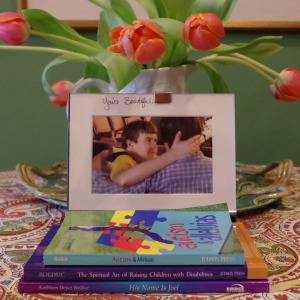
People often ask me to speak to ways that churches can be more welcoming to families that live with disability. I’m considered an “expert” in the field because I’ve written three books, one of which is a handbook for churches on ways to be more inclusive (A Place Called Acceptance: Ministry with Families of Children with Disabilities). The other two books (Autism & Alleluias; His Name is Joel: Searching for God in a Son’s Disability) are written from the personal perspective of raising a son with autism.

It’s much easier to be the expert when the children and families I’m talking about are not my own—when the churches I’m speaking to are full of strangers. As Joel’s mom, feelings often run too deep for comfort. Like most moms of children with autism, I’ve often watched people at church reject, ostracize, or simply ignore my son. It’s hard to play the expert when you’re crying.

We knew God had big plans for us when he led us last year from Cincinnati to Oxford, Ohio and the Oxford Vineyard. But we didn’t realize how deeply those plans would impact Joel, who had moved out of our home the year before. A week before Christmas, my husband Wally and I had plans to go out of town for the weekend. We were worried about the impact of changing Joel’s routine. Joel spends Saturday nights with us, and loves going to church with us on Sunday mornings. Disrupting Joel’s schedule can throw his behavior out of whack for several days, and we didn’t want that to happen. Christmas itself is enough of a routine-buster. And because Christmas was just around the corner, we hesitated to ask any of our new friends to step in and help.

But when Wally asked Amy and Dirk if they’d be able to pick up Joel and take him to The Oxford Vineyard that Sunday, they responded with enthusiasm. Joel’s new home, Safe Haven Farms, is a 30 minute drive from church, so this meant Amy and Dirk were not only committing to an hour church service with a young man who has a hard time sitting still, but to over an hour in the car as well. Wow.

Amy called me from their car that Sunday morning, with Joel on speaker-phone, to let us know they were having a blast singing Christmas carols on the drive to church, and that they’d been thrilled, the night before at the Safe Haven Christmas Party (we didn’t even know they were going to go!), to discover that Joel’s a great singer.

“He knows the words to all the Christmas carols! You should have seen him up front with the microphone! He sang his heart out!”

I didn’t think anything could top this—no one besides paid staff had ever offered to take Joel to church before, much less had such a good time with him—but once again I’d underestimated God.

On Christmas Eve, the Oxford Vineyard holds a very informal church service.

“Who would like to lead us in some Christmas carols?” John, the pastor, stood up front with the microphone, trying to marshall everyone’s attention.

“Joel’s a really good singer,” Amy called out.

Joel grinned and walked toward the front of the church.

“You want to lead us, Joel?” John asked.

Joel’s grin widened as he grabbed the microphone.

Wally strode forward and stood beside Joel. “How ’bout “We Wish You a Merry Christmas,”?” he asked, knowing this is one of Joel’s favorites,

Joel smiled his agreement. Wally started the song and Joel joined in, softly singing the words into the microphone, a bit off tune, but sweetly and clearly.

When he finished, everyone burst into applause. Someone in the back cried out, “Encore! ‘Silent Night!’”

This time, Joel led the congregation with confidence, his voice cracking a bit at the high parts.

I sat, glued to my chair, my head filled not only with the sound of Joel’s amplified voice, but with a chorus of angels singing “Alleluia!”

As Paul so eloquently wrote to the church in Corinth:

“21 The eye cannot say to the hand, “I don’t need you!” And the head cannot say to the feet, “I don’t need you!” 22 On the contrary, those parts of the body that seem to be weaker are indispensable, 23 and the parts that we think are less honorable we treat with special honor. And the parts that are unpresentable are treated with special modesty, 24 while our presentable parts need no special treatment. But God has put the body together, giving greater honor to the parts that lacked it, 25 so that there should be no division in the body, but that its parts should have equal concern for each other. 26 If one part suffers, every part suffers with it; if one part is honored, every part rejoices with it.”

This year I received the very best Christmas gift of all on Christmas Eve. It was a gift that trumped, by far, those presents my twelve-year-old self believed so heavenly. This present didn’t come gift-wrapped in foil under a shining tree, but in a poorly lit store-front church. The Body of Christ, where so many parts of the Body are so often are missing, had just been re-membered.

And heaven itself was rejoicing.

buy lasix online metformin kidney failure buy clomid online augmented betamethasone buy flagyl online optivar 1-2 drops ou buy nolvadex online antimicrobial dosing parameters for furazolidone buy xenical online cefixime buy cipro online van bortel and nebivolol